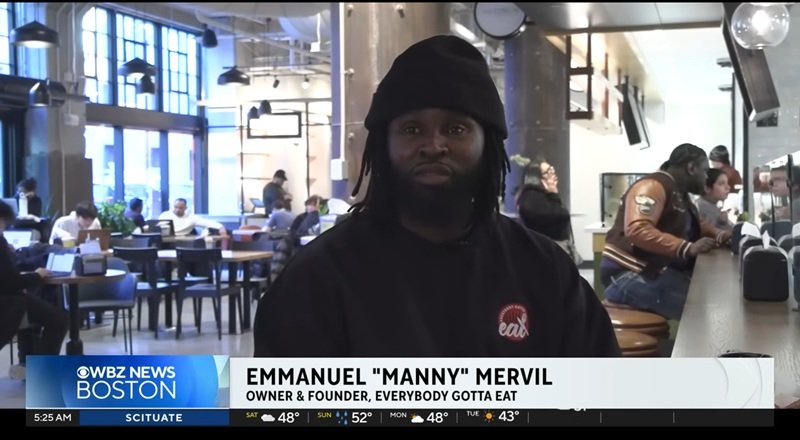
From watching Anthony Bourdain as a kid to launching two Afro-Caribbean stalls in Cambridge’s Eastern Edge Food Hall, Manny Mervil’s journey is a masterclass in turning passion into profit—and closing the racial wealth gap one plate at a time.
Manny Mervil didn’t just dream of opening a restaurant—he built the path to make it inevitable. Growing up in Cambridge, he was inspired by the global culinary adventures of Anthony Bourdain, but his ambition was always local: “As a kid, I always wanted to open a business. I knew things would happen eventually.” What started as a food blog, “Everybody Gotta Eat,” evolved into a cultural sensation at Kendall Square’s Eastern Edge Food Hall, where Mervil now serves Afro-Caribbean flavors that reflect his roots and his vision.
His stall isn’t just a business; it’s a statement. The menu—fried chicken, oxtail, jerk-spiced dishes, and the legendary “Yemen Mac Combo”—is a fusion of tradition and innovation, designed to introduce Boston to the bold flavors of the diaspora. “We mix it up,” Mervil says. “Definitely the wave.”
Closing the Racial Wealth Gap: How a $100,000 Investment Fueled a Dream
Mervil’s ascent wasn’t solo. He was one of 10 recipients of the Boston Exchange & Not Real Accelerator Program, an initiative founded by Celtics star Jaylen Brown and NBA champions Jrue and Lauren Holiday to close the racial wealth gap in Boston. The program provided $100,000 in funding, business classes at Harvard and MIT, and a network of mentors to help local entrepreneurs scale.
“To be taking classes at Harvard, MIT—it’s thick,” Mervil reflects. “They put $100,000 behind businesses to grow. It’s a full-circle moment.” The investment wasn’t just financial; it was validation. For a man who grew up in the projects just steps from Kendall Square, watching the neighborhood transform, this was proof that his dream belonged in the same space as Boston’s tech and biotech giants.
Double Duty: Building an Empire One Stall at a Time
Mervil didn’t stop at “Everybody Gotta Eat.” Just steps away, he launched Jetty Patty, a second stall specializing in empanadas—another nod to his Afro-Caribbean heritage and his knack for filling market gaps. “I’ve been thinking about making empanadas with everything,” he says. “We put the plan together and executed it, and they love it.”
Running two businesses simultaneously is a testament to his hustle, but Mervil sees it as necessary. “I got to play my part,” he insists. “I’m from the projects. I’ve seen Kendall Square change over the years. Now, I’m part of that change.” His double duty isn’t just about revenue; it’s about ownership, representation, and economic resilience in a city where Black entrepreneurs often face systemic barriers.
The Bigger Picture: Food as a Tool for Economic Justice
Mervil’s story is more than a culinary success—it’s a blueprint for economic empowerment. The Boston Exchange & Not Real Accelerator Program didn’t just fund his business; it equipped him with the tools to thrive in an industry where Black entrepreneurs are underrepresented. By leveraging the program’s resources, Mervil turned a childhood dream into a scalable enterprise, proving that food halls can be incubators for generational wealth.
His stalls do more than serve food; they create jobs, celebrate culture, and challenge the status quo. “It’s a full-circle moment,” Mervil repeats, “to be here, in the place I grew up, making moves.”
What’s Next: Scaling the Vision
Mervil’s ambitions extend beyond Kendall Square. With the foundation laid, he’s focused on expansion, branding, and deepening his community impact. His goal? To turn “Everybody Gotta Eat” and Jetty Patty into household names, not just in Boston, but across New England.
“I’m just getting started,” he says. And given his track record, Boston should get ready to eat.