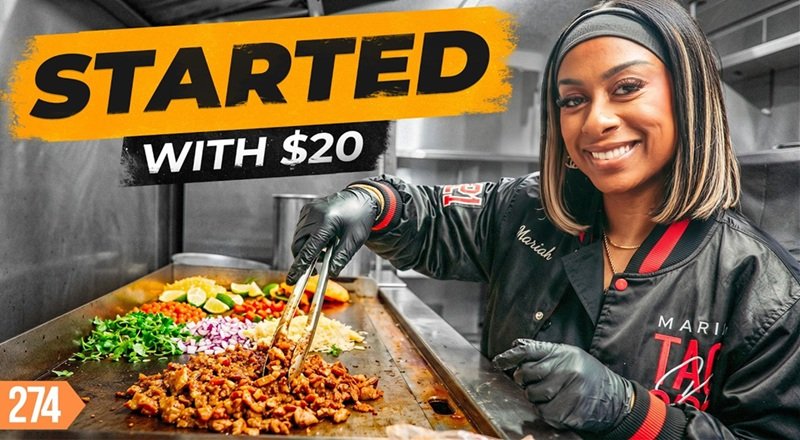
From selling tacos out of her apartment to catering a Michael Jordan sneaker launch, Mariah turned a $20 griddle, a viral Instagram post, and relentless consistency into a $500K/year food truck business—with zero ads and no investors.
Mariah’s story begins not with a business plan or a loan, but with boredom, a pandemic, and a $20 griddle from Target. After losing her bartending job and feeling stuck in a corporate role, she stumbled upon a YouTube recipe for birria tacos, made a batch, and posted it on Instagram. “Someone commented, ‘You should sell these,’” she recalls. “I thought, ‘I’m in my apartment—how’s that going to work?’ But I gave it a shot.”
That first day, cars lined up around her apartment building. With two friends helping her run food downstairs, Mariah sold out—proving that opportunity doesn’t wait for perfection. “I realized this was real,” she says. “I had to legitimize it before the health department shut me down.”
Key Insight: Mariah’s first lesson in entrepreneurship wasn’t about capital—it was about starting before you’re ready. “If I had waited for the ‘right’ time, I’d still be waiting,” she admits.
From Apartment to Ghost Kitchen: The Power of Momentum
Within weeks, Mariah moved into a ghost kitchen, scaling her operation while keeping costs lean. Her strategy was simple:
- No Paid Ads: She grew her following organically, using Instagram and TikTok to post daily updates, respond to DMs, and build a community. “I’m the only one who runs social media,” she says. “People buy from people, not logos.”
- Consistency Over Perfection: She showed up every day, rain or shine, with the same energy. “I didn’t have a fancy team—just good food and reliability.”
- Word of Mouth: Her $15.99 taco-and-wings combo became a Charlotte staple, with customers lining up for her signature roasted wings and birria consommé.
Result: A cult following that turned her side hustle into a six-figure business in under a year.
The Numbers Behind the Tacos: How a $14K Week Breaks Down
Mariah’s transparency with finances offers a masterclass in bootstrapped scaling. On an average week (5–6 days, no private events), her numbers look like this:
| Revenue | $14,000 |
|---|---|
| Food Costs | $1,500 |
| Gas (Truck + Generator) | $300 |
| Labor (30 hrs @ $15/hr) | $450 |
| Insurance | $79 (weekly) |
| Commissary Kitchen | $450 |
| Profit (Pre-Tax) | ~$11,221 |
Profit Margins: ~15% (with spikes up to 25% on high-volume weeks).
Take-Home Pay: $10K+/month—all from a food truck.
Why It Works:
- Low Overhead: “We keep costs as low as humanly possible,” she says. “That’s how you see real profit.”
- Private Events: Bookings like the Michael Jordan sneaker launch ($20K in one weekend) boost revenue without extra marketing.
- No Waste: “The food will never go to waste,” she insists. “If we don’t sell out, I take it home or give it away.”
The Michael Jordan Effect: How One Event Changed Everything
Mariah’s biggest break came when she was booked for a three-day private event for Michael Jordan. “They put a basketball court outside, gave away free shoes—it was surreal,” she recalls. The event netted $20,000 and cemented her reputation as Charlotte’s go-to taco spot.
Lessons from the Gig:
- High-Profile = High Stakes: “We fed the community and made great money, but the pressure was real,” she admits.
- Scaling Smart: She reinvested profits into better equipment and staff, but avoided debt. “I bought a second food truck and sold it—it was too much to manage.”
- Brand Loyalty: “People don’t just come for the food; they come for the experience,” she says. “We treat every customer like family.”
The Brick-and-Mortar Gamble: Why a $20 Griddle Led to a Storefront
In 2024, Mariah made a bold move: she’s building her first brick-and-mortar location—a $200K+ investment in a growing Charlotte neighborhood. “I know it’s expensive, but the ROI will be worth it,” she says.
Why Brick-and-Mortar?
- Stability: “People struggle to track the food truck,” she explains. “A fixed location means consistent foot traffic.”
- Expanded Menu: She’ll add alcohol sales (a major revenue booster) and dine-in seating.
- Community Anchor: “I want to be a staple,” she says. “A place where people can sit, enjoy the food, and feel at home.”
Risk vs. Reward:
- She sold a second food truck to fund the buildout. “It was a lot to manage,” she admits. “Focus is everything.”
- Location Matters: The spot is near a new apartment complex, ensuring built-in demand.
Mariah’s 5 Rules for Turning $20 into $500K
- Start Where You Are:
- “I used my last $20 on a griddle,” she says. “You don’t need much—just a willingness to begin.”
- Social Media = Free Marketing:
- 45K Instagram followers and 18K on TikTok—all organic. “Post daily, engage with your audience, and be yourself.”
- Keep It Stupid Simple (KISS):
- “Overcomplicating your menu kills efficiency,” she warns. “We sell tacos, wings, and rice—that’s it.”
- Reinvest, Don’t Splurge:
- “Every dollar went back into the business,” she says. “No fancy cars, no ego spends—just growth.”
- Customer Obsession:
- “I respond to every DM, every comment,” she says. “People support those who care about them.”
The Taco That Built a Legacy
Mariah’s signature birria taco—slow-cooked beef, crispy cheese, and a consommé dip—isn’t just a menu item; it’s a symbol of her journey. “We started with two shirts and a dream,” she says. “Now, we’re feeding thousands.”
Final Word: “If you have a dream that keeps you up at night, do it,” she urges. “The $20 griddle changed my life. Imagine what yours could do.”