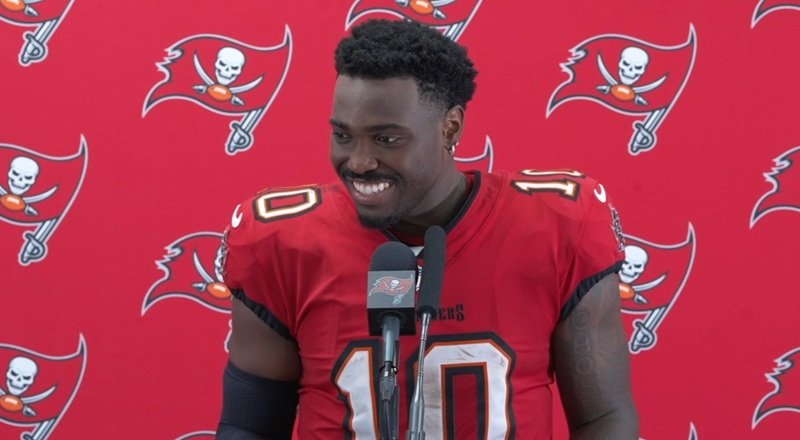
Tampa Bay quarterback Jalon Daniels turned an undrafted weekend into a three-year, $3.125 million NFL contract, and he showed up to the league already owning a home and running a nonprofit. His story is a feel-good one with a real blueprint inside it for anyone turning a first big check into something that lasts.
The headline says millionaire, but the contract says something else.
Jalon Daniels, 23, went undrafted in April after six seasons at Kansas. He signed with the Buccaneers as an undrafted free agent, made the roster, and has already started and won a game while Baker Mayfield recovered from injury.
His deal runs through 2028 at a total value of $3,125,000, an average of roughly $1.04 million a year. According to Spotrac and Over The Cap, it breaks down like this:
| Year | Base salary | Cap hit (approx.) | Dead money if released (approx.) |
|---|---|---|---|
| 2026 | $885,000 | $893,000–$900,000 | $272,500–$279,000 |
| 2027 | $1,050,000 | $1,058,000 | $16,667 |
| 2028 | $1,165,000 | $1,173,000 | $8,334 |
The signing bonus is $25,000 and the total guarantee is $272,500. That means about 91% of the contract, roughly $2.85 million, is contingent on Daniels staying on the roster.
Dead money is the cap charge a team absorbs when it cuts a player. Think of it as the early-termination fee on a lease. After this season, Tampa Bay’s fee to walk away from Daniels drops to under $17,000, so the team holds the option and he carries the risk.
That is how deals are built for players without draft leverage. Late-round drafted quarterbacks in the same class received larger guarantees and four-year terms. Daniels’ contract ranks 86th of 110 among quarterbacks on Over The Cap. Even so, his agent, Aaron Henderson of Klutch Sports Group, secured a guarantee that ranked roughly 21st among the several hundred 2026 undrafted deals that carried one.
Next, consider the cash. Spotrac puts his 2026 earnings at about $916,802, which is gross. Federal and state taxes, an agent commission that typically runs 3%, and living costs all come out of it. His career NFL cash is still under $1 million before any of those deductions.
Online net-worth sites peg him near $2 million. Those figures are built from social-media metrics, not disclosed assets or liabilities, and no verified net-worth figure exists. The same caution applies to his college NIL valuations, which ranged from $270,000 to $431,000. Those were market estimates of what he could command, not money he received.
What is documented is more instructive. Daniels began earning NIL income around 2021, with partners including Adidas, Wendy’s, Applebee’s, Pepsi, EA Sports, Amazon Prime Video, and Meritrust Credit Union. A profile in The Athletic described him dividing that income across savings, a home purchase, life insurance, personal spending, and nonprofit work. He built credit deliberately and bought a home in Kansas at 22. He funded MOM2JD6, a nonprofit supporting single mothers and their children, named in reference to his own mother. A stepparent had trained him on spreadsheets and banking apps.
That last detail matters because the racial wealth gap is partly a gap in inherited financial systems, the routines one generation hands to the next. Daniels inherited routines rather than capital, and he converted temporary income into a durable asset before the larger checks arrived.
His leverage now depends on performance. He becomes a restricted free agent in 2029, which gives Tampa Bay certain matching rights if he has accrued enough seasons. Every start between now and then is an audition for the contract that actually carries guarantees.
Strategic Playbook
1. Ask what is guaranteed. Any compensation package has a headline and a floor. Equity that hasn’t vested, discretionary bonuses, and earn-outs in an acquisition are all non-guaranteed base salary by another name. Build your financial plan on the floor: Daniels’ real number is $272,500 until he earns the rest.
2. Convert volatile income into fixed assets early. NIL money, commissions, and contract revenue can disappear in a season. Daniels moved a share of his into home equity and insurance while it was flowing. Founders and commission earners can apply the same logic by assigning each windfall a destination before it lands.
3. Read the termination terms before the pay terms. Dead money shows who holds the power in a deal. In your own contracts, look at severance, vesting acceleration, notice periods, and kill fees. If the other side can exit for almost nothing, negotiate that clause or price the risk into your rate.
4. Treat the first contract as a proving ground. Daniels’ deal is low-tier by design, but it puts him on the field, and his starts will set the terms of the next negotiation. Professionals taking a below-market first role should know exactly which results reset their leverage and when the window to renegotiate opens.