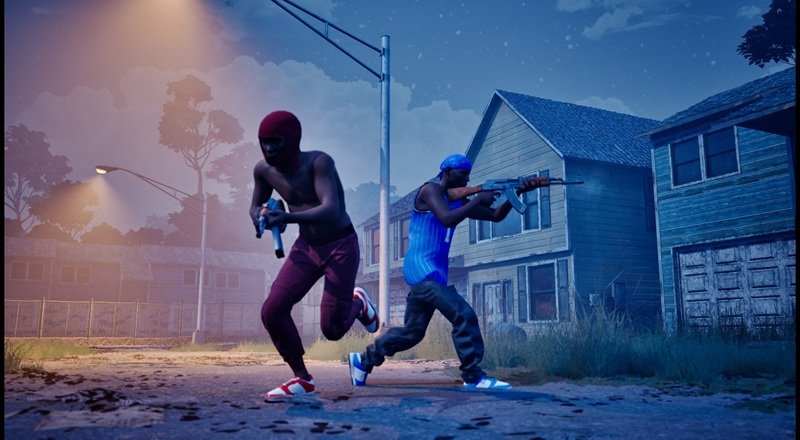
A $5.99 Shooter Went Viral. Here’s the Business Lesson for Black Game Founders
A small studio turned Chicago street iconography into a viral Steam launch. The spike shows how much Black culture is worth in digital entertainment, and how little of that value reaches the communities whose culture is being sold unless Black creators own the intellectual property.
The numbers came fast. Trapstar Games released Hood Warfare 2 on Steam on October 8. Within about four days it hit an all-time peak of 4,491 concurrent players. Its predecessor, the 2023 Detroit-set Hood Warfare, never got past roughly 68. That is about a 66x jump in peak engagement, driven by gameplay clips on X, including from Rainbow Six Siege pro Merc, comparing its movement and killstreaks favorably to Call of Duty.
The product is not novel, and that is the point. Strip away the names and every mode is a standard shooter format. “GangBang” is team deathmatch. “Hit A Lick” is capture-the-flag. “Chain Snatch” is kill-confirmed. The “Snitch” killstreak is a UAV radar. The studio didn’t invent new mechanics. It took familiar ones and wrapped them in red-and-blue street culture, sold at an impulse price.
In business terms, the culture is the differentiator. Call of Duty runs on a reported multi-thousand-person development pipeline. A small team cannot compete on polish, so it competes on identity, and identity here means Black and Latino street life rendered as entertainment.
The Unit Economics
Here is a rough look at what a launch like this earns. Third-party trackers estimate owners from the mid-to-high thousands to the low tens of thousands. Take an illustrative 15,000 copies sold at the $5.39 launch-discount price:
- Gross revenue: about $81,000
- Steam’s 30% platform cut: about $24,000
- Net to the studio before refunds and taxes: about $57,000
That is real money for a small studio, but not a fortune. The upside depends on staying power. The original title kept a Mostly Positive rating, about 75% across some 248 reviews, while staying commercially tiny. The sequel holds the same 75% across roughly 389 reviews. Reviewers praise the chaotic fun and low price, and criticize spawn camping, netcode, cheating, and what several call novelty wearing off.
This is the core risk of a viral launch. A spike in attention is not a business. Low price plus viral reach gets people to buy once. Keeping them playing, through cosmetics, new maps, and post-launch content, is what builds a valuation. The studio’s roadmap of new maps, weapons, attachments, and skins suggests it knows this. Skins unlocked through progression can later become a cosmetics store, which is where free-to-play shooters make most of their money.
The Real Asset: Speed After Launch
For a studio this size, the launch is not the product. What happens in the first two weeks is. Trapstar seems to understand that. Four days after release, patch 1.0.10 added voice chat, strengthened the anti-cheat, fixed bugs, and adjusted spawns. Spawn camping and cheating are the two complaints that come up most often in player reviews, so the patch went straight at them.
That speed matters financially. Steam reviews have climbed past 400 and are holding at about 75% positive. Reviews work like a credit score for a digital storefront: once a game’s rating settles, it shapes how the store promotes it and whether a browsing buyer clicks “purchase.” Fixing problems while the review count is still small protects that score before it hardens.
The studio also bought itself the ability to move fast. Switching from Unity to Unreal Engine 5 between games was a capital decision as much as a creative one. It raised visual quality enough to stand up next to Call of Duty in side-by-side clips, and those clips drove the sales. The clips also cost the studio nothing. Footage from Rainbow Six Siege pro Merc reached millions of viewers, the kind of reach a small studio could never buy.
Free attention is borrowed, though. With no critic reviews yet and players already warning that the novelty fades, Trapstar has weeks, not months, to turn curiosity into habit. The roadmap’s promise of new maps, weapons, and cosmetics will decide whether this becomes a business or a moment.
Strategic Playbook
1. Treat cultural authenticity as a defensible moat, and own the IP. A shooter mechanic can be copied in a weekend. A credible, lived-in world cannot. Black founders entering games should lock down trademarks, character copyrights, and world-building assets early, before a distribution deal. Ownership of the IP is the difference between licensing fees and a one-time work-for-hire check.
2. Know your toll booths before you price. Steam takes 30% of revenue, falling to 25% after $10 million and 20% after $50 million. Epic’s Unreal Engine charges a 5% royalty on gross revenue above $1 million per title. At a $5.99 price, those tiers shape whether you can fund ongoing content. Model your break-even on net revenue after platform and engine fees, not on the sticker price.
3. Build creator distribution into your launch budget. Hood Warfare 2 didn’t need a marketing agency. It needed clips from people with audiences. Structured creator partnerships, with early access keys, revenue-share affiliate codes, and custom content drops, are the cheapest customer acquisition in gaming. Black creators with gaming audiences are a distribution channel to treat as partners, with real equity or revenue participation.
4. Plan for retention before launch. A viral spike decays fast; reviewers are already flagging thin long-term depth. The studios that turn a moment into a company have a 90-day content calendar, a cosmetics strategy, and anti-cheat and netcode fixes ready to ship. For investors and angels looking at small game studios, the key question isn’t launch-week peaks. Ask what players are still doing in month three, and who owns the world they’re doing it in.