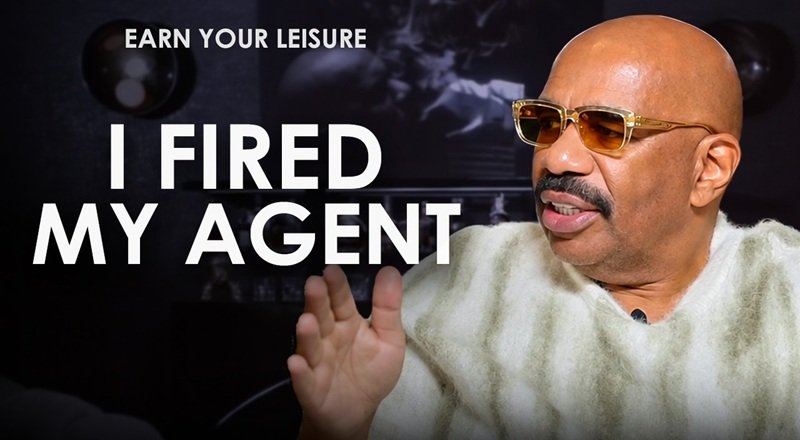
The Consigliere Model: How Steve Harvey Fired the Hollywood Middlemen and Took Back His Margin
In entertainment, sports, and corporate contracting alike, percentage-based intermediaries can quietly consume a quarter or more of gross earnings before taxes are even assessed. Steve Harvey’s shift from commission-based representation to an in-house, retained deal-maker is a blueprint for any high earner who wants to keep more of what they produce.
Hollywood sells an image of abundance, but Steve Harvey calls it the “land of illusion.” Speaking with Earn Your Leisure, the Family Feud host broke down the business model behind the red carpet. The problem isn’t that talent is underpaid. It’s that talent pays everyone else first.
The standard representation stack works like this. An agent takes 10% of a deal. Under the arrangement Harvey describes, an entertainment attorney takes 5% of the contract for its full duration, so a five-year deal means five years of payments. A manager, often a friend from the early days, adds anywhere from 5% to 20%. Taken together, Harvey estimates 15% to 30% of gross income disappears “off the dribble,” before any tax liability.
On a $1 million deal, that’s up to $300,000 gone. Then come federal income tax at a top marginal rate of 37%, California’s state income tax (which tops out above 13%), and payroll and other levies. Harvey’s rough math lands near 70% of every dollar gone. His exact numbers are conversational, but the conclusion holds. A headline salary and real take-home pay can be wildly different figures.
A Closed Referral Loop
The most damning part of his analysis concerns how agents earn their 10%. Harvey argues many aren’t actively “beating the bushes” to find work for clients. They list talent on a roster, wait for a buyer to call, and collect. Then the agent refers the deal to a preferred attorney, often a close associate, and the talent, “so busy being happy to be on TV,” signs on. This is a closed referral loop, where the incentives favor the intermediaries’ relationships over the client’s net income.
The Backend Mirage
Then there’s the illusion of equity. Harvey says he owned 12% of the backend of The Steve Harvey Show on The WB and never received a dime. Studios use what the industry calls “Hollywood accounting.” Production, distribution, and overhead costs are allocated so that a profitable show can still report no net profit to participants. Harvey’s verdict is blunt: in TV and music, backend points often exist on paper only. Book publishing, in his experience, was the exception.
Hiring a Consigliere
His fix came from an unexpected place: The Godfather. Watching Tom Hagen, the family’s consigliere, negotiate on the Corleones’ behalf, Harvey realized he needed a single trusted deal-maker, not a rotating cast of commissioned middlemen. He recruited Brandon Williams, a mergers and acquisitions attorney at a major firm who had handled business deals for him. As old contracts expired, Harvey cut the percentage-based attorneys and agents out one by one.
Today, he says, nobody gets 10%, and nobody gets 5%. Agencies like IMG can still package specific deals, but that compensation is negotiated between the agency and the network, not taken from Harvey’s gross. His principle is simple: pay a lawyer for hours worked, not a permanent share of your career.
Where Leverage Runs Out
The model has limits, and Harvey is honest about them. When he signed with Fremantle to host Family Feud in 2010, he was in tax trouble and needed cash, so he accepted a salary without ownership in a franchise that was already decades old. Ownership was never on the table. Instead, he leveraged his tenure and ratings to negotiate compensation that, in his words, makes him feel like an owner. It’s a reminder that leverage builds over time, and early decisions made under financial pressure can shape a career for decades.
Harvey also points to the ownership benchmark set by Oprah Winfrey and Tyler Perry. Perry owns his studio and his library outright, the strongest form of leverage in the business.
Strategic Playbook
1. Audit your “intermediary drag.” Add up every percentage-based fee on your income: agents, managers, recruiters, financial advisors charging assets-under-management fees, brokers. A 1% annual advisory fee on a $2 million portfolio is $20,000 a year, every year, whether or not the advisor outperforms. Calculate the total as a share of gross income, then ask what each party is actually doing to earn it.
2. Convert perpetual percentages into fixed or hourly fees. Harvey’s question to lawyers applies everywhere: what’s your rate, and how many hours will this take? Illustratively, 5% of a $10 million, five-year deal is $500,000. Even 150 hours at a premium $1,000 hourly rate is $150,000. Flat-fee financial planners, fixed-fee legal retainers, and capped success fees all let you buy expertise without giving up equity in your future.
3. Build your consigliere relationship early. Find one trusted, technically strong advisor, ideally with transactional or M&A experience, whose incentives line up with yours. Retain them, or make them an equity partner in your holding company. High earners often route income through a loan-out corporation, a company that “lends” your services to buyers, which can make professional fees deductible and add liability protection. A tax attorney and CPA should set that up.
4. Treat “backend” as zero until proven otherwise. Points on net profit are among the weakest forms of equity. Negotiate for guaranteed money up front, points on gross receipts, audit rights, or outright ownership of intellectual property. If you can’t get ownership, do what Harvey did: build leverage through performance and push for compensation that reflects the value you create.