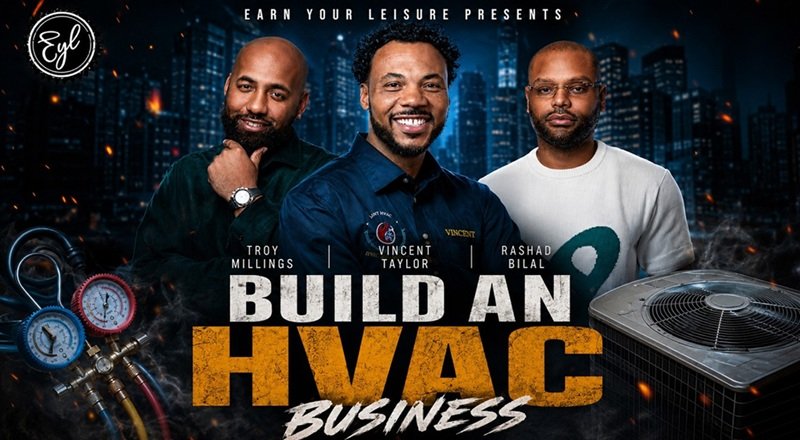
A $3,000 Payday and the Birth of a Business
Vincent Taylor’s journey into the HVAC industry didn’t begin with a grand vision or a family legacy—it started with desperation, audacity, and a $300 ad in the PennySaver. At 28, facing the pressure of marriage, homeownership, and the realization that his past hustles wouldn’t sustain his future, Vincent made a decision: He refused to be broke at 30.
With just $30,000 to his name, he turned to his cousin—a schoolteacher with a clean record and a knack for organization—and proposed a bold experiment. They’d flip a coin: If the ad generated a job, they’d pursue HVAC. If not, they’d walk away. The coin landed on heads. The ad ran. And within two weeks, a call came in: “Come to our house in Yonkers. We want to put in a boiler.”
There was just one problem: Vincent had no idea what a boiler was.
But he had something more valuable—confidence, resourcefulness, and a father who was a seasoned HVAC technician. He showed up, quoted the job, and walked out with $6,000 in cash. After paying his father $1,000 to install the boiler and $300 for parts, Vincent cleared $3,000 in a single day without lifting a finger. That moment ignited a fire. “We made $3,000 without doing any work,” he recalls. “I knew then: This trade could change my life.”
The Hustle: From Apprentice to Entrepreneur
Vincent’s early strategy was simple: Leverage the skills of others while he learned the business. He hired technicians—many of them immigrants with deep trade experience—and let them handle the mechanical work while he focused on sales, operations, and scaling. But he quickly realized that to truly own his destiny, he needed to master the craft himself.
So, while running a company with three trucks on the road, Vincent enrolled in night classes at BOCES, a trade school. “I was making more money than the teachers,” he laughs, “but I knew I had to learn.” He absorbed everything—EPA certification, thermostat wiring, transformer mechanics—and soon, he was the one training others.
His first year as a solo entrepreneur? $180,000 in revenue. By year two, he was clearing $280,000–$380,000 annually, all while providing for his family and reinvesting in his business. “Coming from where I came from, that was Hollywood,” he says. “I was living the American Dream.”
The Blueprint: How to Start an HVAC Business With No Experience
Vincent’s story isn’t just inspiring—it’s replicable. Here’s his step-by-step roadmap for anyone looking to break into the HVAC industry, whether as a technician or an entrepreneur.
Step 1: Get Certified (The Fast Track)
You don’t need a college degree—or even prior experience—to start. The EPA 608 Certification is your golden ticket. It’s a 100-question test (25 questions per section) covering Type I, Type II, and Universal refrigeration handling. Once you pass, you’re legally allowed to buy and handle refrigerant gases—a requirement for any HVAC work.
- Cost: ~$120–$150 (varies by provider).
- Study Time: 2–3 weeks of focused prep using free online resources or practice exams.
- Lifelong Validity: No renewals required.
“My cousin bought the EPA test on a Friday, studied over the weekend, and passed on Monday,” Vincent says. “She knew nothing about HVAC. But that certification got us in the door.”
Pro Tip: Use Mainstream Engineering’s 608 study materials (free online) to prepare.
Step 2: Choose Your Path—Install or Service?
HVAC offers two primary career tracks, each with its own rewards:
| Path | Pros | Cons | Earning Potential |
|---|---|---|---|
| Installation | High demand, steady work, team environment | Physically demanding, heavy lifting | $75,000–$120,000/year |
| Service/Repair | Higher margins, problem-solving, independence | Requires deeper technical knowledge | $80,000–$150,000+/year |
“Installers are the muscle—service techs are the brains,” Vincent explains. “But both can make you rich.”
Biggest Money-Makers in HVAC:
- Transformers ($16–$30 cost) → $500–$600 service call
- Thermostats ($100–$400 cost) → $800+ install
- Freon (R22, R410A, R32) → $150–$300 per pound (summer = gold rush season)
“In HVAC, you make the most money off your lowest-cost parts,” Vincent says. “A $20 transformer can turn into a $600 job. That’s the beauty of the trade.”
Step 3: Get Licensed and Legal
To operate as a business, you’ll need:
- Business Structure:
- Sole Proprietorship ($35 filing fee) – Quickest and cheapest for beginners.
- LLC ($100–$500) – Recommended for liability protection.
- Insurance:
- General Liability ($100–$300/month) – Covers accidents/damages.
- Auto Insurance (for work vans/trucks).
- Local Licenses & Permits:
- Varies by state/county (e.g., Westchester, NY, requires a Home Improvement Contractor License).
“You can start with just a business name, bank account, and insurance,” Vincent advises. “The rest comes with experience.”
Step 4: Get the Work (The Hardest Part)
“Most people can buy a van and get certified—but getting customers is where the real battle begins,” Vincent says. Here’s how he did it:
A. Leverage Your Network
- Government Contracts: Vincent landed a $1.1M military base maintenance contract by getting his CAGE Code (federal vendor ID) and 8(a) Certification (for minority-owned businesses).
- 8(a) Perk: No-bid contracts up to $4M for qualified businesses.
- Partnerships: Team up with general contractors, real estate developers, and property managers for steady work.
B. Door-to-Door & Cold Outreach
- Target affluent neighborhoods (higher budgets = bigger jobs).
- Offer free inspections to build trust.
C. Social Media & Branding
- Vincent gained 5,000+ Instagram followers in months by posting HVAC tips, job highlights, and behind-the-scenes content.
- Pro Tip: “People buy from people they like. Show your face, your work, and your personality.”
D. Maintenance Contracts = Recurring Revenue
- $400–$600 per condenser cleaning
- $1,000+ for annual HVAC tune-ups
- “Maintenance is the easiest money in HVAC,” Vincent says. “No heavy lifting—just show up, service, and collect.”
Step 5: Invest in Tools & Equipment
A well-stocked HVAC truck is a rolling goldmine. Here’s what you’ll need:
| Tool/Equipment | Cost | Why It’s Essential |
|---|---|---|
| Hand Tools (wrenches, pliers, etc.) | $1,000–$2,000 | Daily use for installations/repairs |
| Gauges (for refrigerant) | $600–$1,500 | Required for AC work |
| Veto Pro Pac Tool Bags | $200–$600 | Durable, organized storage |
| Prop Press Machine | $1,500–$3,000 | Replaces soldering for copper pipes |
| Work Van/Truck | $20,000–$50,000 | Mobile workshop + branding |
“A fully loaded HVAC truck can have $20K–$30K in tools,” Vincent says. “But every tool pays for itself in one or two jobs.”
Step 6: Hire Smart (Avoid Costly Mistakes)
Vincent’s #1 hiring rule: “I don’t hire anyone over 25.”
Why?
- Younger workers (18–25) are hungry, moldable, and less likely to resent your success.
- Older workers often have financial pressures (mortgages, kids, etc.) that lead to resentment when they see you making more.
Red Flags in Hiring:
1. Overconfidence without proof – “If they say ‘I’m the best,’ make them prove it.”
2. Lack of hunger – “If they’re not early, not eager, not teachable—walk away.”
3. Hidden agendas – “Some people just want to learn your business to start their own.”
Vincent’s Hiring Hack:
- Pay for performance (e.g., $500 bonus for most maintenance contracts sold in a week).
- Train like family – “Once you work for me, you’re in my family. You come to Thanksgiving, Christmas—you’re part of the team.”
Step 7: Price for Profit (The Art of Value Selling)
“You can’t be the cheapest, and you can’t be the most expensive—you have to be the most trusted,” Vincent says.
His Pricing Strategy:
- Service Call Fee: $135/hour (just to show up).
- Water Heater Install: $2,500–$3,000 (cost: $1,000–$1,200).
- Boiler Cleaning: $400–$600 (takes 1 hour).
- Freon Recharge: $150–$300 per pound (summer = $1,000+ per job).
Lesson from a $46K Bid:
A Russian developer in Manhattan asked Vincent to bid on a water-cooled AC system. Seven competitors quoted $56K–$58K. Vincent came in at $46K—and won.
Why? “The developer told me, ‘I could tell you know what you’re doing. The other guy was cheaper, but I didn’t trust him.’” Moral: Sell your expertise, not just your price.
The Seasonality: Riding the HVAC Wave
HVAC is a seasonal goldmine—if you play it right.
| Season | Peak Services | Earning Potential | Pro Tip |
|---|---|---|---|
| Summer | AC repairs, Freon recharges | $80K–$100K in 3 months | “People can’t live without AC. Charge premium rates.” |
| Winter | Heating systems, boilers | $50K–$80K | “Oil and gas heating = steady income.” |
| Spring/Fall | Maintenance contracts | $30K–$50K | “Preventative maintenance keeps cash flowing year-round.” |
“Summer is the gold rush,” Vincent says. “I’ve made $5K in a single day just off Freon. But winter pays too—people will freeze before they’ll sweat.”
The Mindset: Why the Trades Are the New Wealth Builder
Vincent’s story is a testament to the power of skilled trades in an era where college degrees no longer guarantee success. Here’s why HVAC (and trades in general) are the smartest career move in 2026:
- No Student Debt – Trade school costs $10K–$20K (vs. $100K+ for college).
- High Demand – Shortage of 500,000+ skilled tradespeople in the U.S. (per U.S. Bureau of Labor Statistics).
- Recession-Proof – “People will always need heat, AC, and running water,” Vincent says.
- Path to Ownership – Unlike corporate jobs, you can start a business with minimal capital and scale fast.
- AI-Proof – “Robots can’t fix a broken AC unit in someone’s basement,” Vincent laughs. “This is hands-on work.”
The Black Ownership Gap:
Only 3% of HVAC businesses are Black-owned, despite 30–40% of technicians being Black or Latino. Vincent’s mission? Change that. “We’ve been locked out of these industries for generations,” he says. “Now, the door is open. Walk through it.”
The Legacy: Building Wealth Beyond the Wrench
Today, Vincent Taylor is:
- A professor at Westchester Community College (teaching the next generation of HVAC techs).
- A mentor to dozens of apprentices (many of whom now run their own companies).
- A six-figure earner with multiple revenue streams (installation, service, maintenance, government contracts).
- A living proof that the trades are the fastest path to financial freedom for those willing to hustle, learn, and own their craft.
His final advice?
“If you have a dream that keeps you up at night—do it. If you’re willing to hone in on one skill for one year, I guarantee you: It will change your life. You don’t need a college degree. You don’t need a trust fund. You just need the audacity to hope—and the willingness to get your hands dirty.”
Key Takeaways: Vincent Taylor’s HVAC Success Formula
- Start with the EPA 608 Certification – Your $150 ticket to the industry.
- Learn on the Job – Work for a company first, then branch out on your own.
- Invest in Tools – A $20K truck setup pays for itself in 2–3 jobs.
- Master Sales & Marketing – Social media, networking, and value selling = steady clients.
- Hire Young & Hungry – 18–25-year-olds are your best bet for loyalty and growth.
- Diversify Revenue – Installation + service + maintenance + government contracts = financial stability.
- Think Like an Owner – “You’re not just a tech—you’re a businessman.”
The Bottom Line
Vincent Taylor’s story is proof that the American Dream is still alive—you just have to build it with your own two hands. In a world where AI, automation, and economic uncertainty dominate headlines, the trades offer a rare, tangible path to wealth that can’t be outsourced or replaced by a machine.
So, if you’re sitting on the sidelines, waiting for the “perfect” opportunity—stop waiting. As Vincent would say:
“The $20 griddle from Target put us where we are today. What’s your excuse?”
Ready to start? Drop a comment below: What’s the first step YOU’LL take to break into the trades?