The Roots of a Financial Empire: A Great-Grandmother’s Legacy
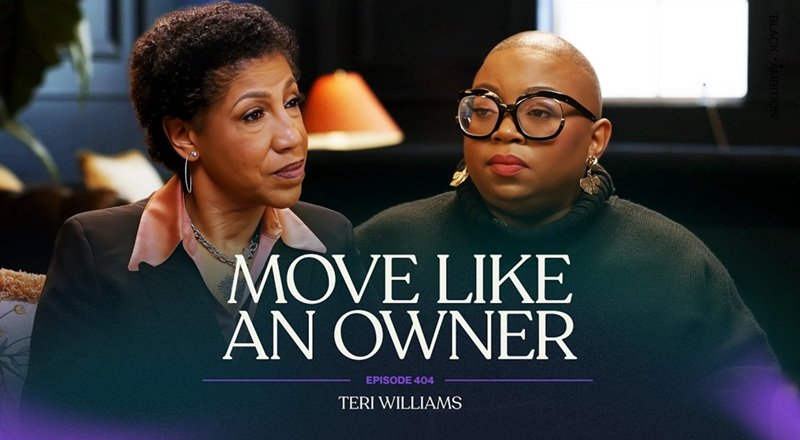
Teri Williams, the President and CEO of OneUnited Bank, didn’t always embrace the entrepreneurial spirit that now defines her career. In fact, for much of her life, she buried it—along with the lessons of the woman who planted the seed: her great-grandmother.
Growing up in Indiantown, Florida, a small, segregated town where White families lived on one side of the railroad tracks and Black families on the other, Teri’s great-grandmother was a force of nature. She owned a barbecue pit, a candy store, a juke joint, and apartments—and young Teri would follow her around as she collected rent. “I didn’t think of her as a businesswoman,” Teri admits. “She was just my great-grandmother.”
Lessons Learned Early in Life Birthed a Powerful Bank Executive
But those early experiences shaped her understanding of money, ownership, and resilience in ways she wouldn’t fully grasp until decades later. “All the lessons I learned, the journey I’ve been on—it started with her,” Teri says. Yet, when she left Indiantown for Brown University, she carried shame about her background. “I became ashamed of my roots. Ashamed that I was from this little town.” That shame led her to bury the legacy of her great-grandmother’s hustle—until a moment of reckoning in her 50s forced her to confront it.
“If I had gone to Brown recognizing the power my great-grandmother instilled in me—the fact that what she built had carried our family for generations and protected us from the segregated South—what a difference it would have made,” she reflects. Instead, she was made to feel “less than” in spaces where her culture and background didn’t fit the Ivy League mold.
This disconnect between her roots and her ambition became a defining tension in her life—one that would later fuel her mission to build OneUnited Bank into the largest Black-owned bank in the U.S.
From Brown to Banking: Trusting the Gut That Shame Tried to Silence
Teri’s journey wasn’t a straight line—it was a series of instinctual leaps that defied conventional expectations.
At Brown, she initially wanted to be a math teacher (the only career path she’d been exposed to). But then she took an economics class and fell in love. “Economics brings together money, numbers, and people,” she says. That spark led her to Harvard Business School, where she was one of the few Black students in her class.
But even at Harvard, Teri fought against external pressures. After her first year, she earned honors—and was recruited by top consulting firms and investment banks. Yet, she chose a different path: marketing at American Express. “A lot of the Black students at Harvard were like, ‘Why would you do that? You’re not going to Goldman Sachs or Morgan Stanley?’” she recalls. The expectation was that she owed it to her community to take the most prestigious job available.
Teri wrestled with the decision—so much so that she met with the dean of Harvard Business School. “I said, ‘This is what I want to do, but I’m not sure it’s what I’m supposed to do,’” she remembers. The dean’s response was simple: “You’re not talking about living on the street. This is a good job. Follow your instinct.”
She did. And it was the best decision of her career.
At American Express, Teri learned a critical lesson from her mentor, Ken Chenault (who would later become CEO of Amex): “Go where there are problems.” When given the choice between joining the booming credit card division or the struggling traveler’s check business, she chose the latter. “If you go where things are doing great, people won’t give you credit. But if you go where there’s a problem and fix it, that’s where you’ll get recognized,” Chenault advised.
Within 18 months, Teri turned around the traveler’s check division, saving American Express millions of dollars and earning a promotion to Vice President. That experience cemented her leadership philosophy: Problems are opportunities in disguise.
The Birth of OneUnited Bank: A Mission to Serve the Underserved
Teri’s next bold move came when she and her then-business partner (now husband) Kevin Cohee decided to buy a bank. The idea was born out of frustration: They wanted to create an affinity credit card for Black consumers, but no bank would partner with them.
“We realized: If we want to serve Black folks, we’re going to have to own the bank,” Teri says.
In 1995, they purchased Boston Bank of Commerce—a struggling institution with just $1 million in capital. The consultant they hired warned them: “You can do this with $1 million, but it needs $3 million.” Their response? “We’re doing it anyway.”
It was a risk. They moved from New York to Boston, poured their savings into the bank, and fought to turn it around. There were sleepless nights and moments of doubt. “We became very close to asking, ‘Is this going to work?’” Teri admits. But they persevered, and the bank thrived.
That first acquisition was just the beginning. Over the next 25+ years, Teri and Kevin acquired three more banks, growing OneUnited Bank into a national powerhouse with $650+ million in assets, serving over 100,000 customers—primarily in underserved Black and Latino communities.
The $50 Million Lesson: Failure as the Greatest Teacher
In 2008, the financial crisis hit. OneUnited Bank had invested in Fannie Mae and Freddie Mac securities—and in a single day, they lost $50 million in capital.
“That was a moment when I was like, ‘Wow, this didn’t work,’” Teri recalls. But instead of folding under the pressure, she fought back. “I don’t give myself a lot of time to mourn. My instinct is to fight back and say, ‘I’m going to learn from this, but this isn’t the end.’”
Since then, OneUnited has rebuilt its capital—and then some. The lesson? “The best lessons come when you’re staring into the abyss.” Teri now seeks out people who’ve faced failure because “what you do in that defining moment—when everything is on the line—is where true leadership is revealed.”
The OneUnited Difference: Banking with a Mission
OneUnited Bank isn’t just a financial institution—it’s a movement. Teri’s vision was to make banking cool, accessible, and empowering for communities that had been locked out of traditional financial systems.
Key Innovations:
Digital Banking Pioneer – OneUnited launched its digital bank in 2005, long before most competitors. “There are still banks today where you can’t open an account online,” Teri notes.
Financial Literacy as a Right – Teri wrote “I Got Bank!”, a children’s book about a 10-year-old boy, Jazz Ellington, who saves $2,000 while his family tries to spend it. The book teaches saving, credit, and entrepreneurship—lessons Teri wishes more families would embrace.
AI for Financial Wellness – OneUnited is now launching WiseOne, an AI-driven virtual financial assistant that helps users make smarter money decisions—even if they don’t bank with OneUnited. “AI is the future. Do not run from it. Do not let them make you afraid of it,” Teri urges.
Community-First Products – From two-day early pay to short-term small-dollar loans with no credit checks, OneUnited designs products for real people with real needs.
The Power of Ownership: Why It’s Non-Negotiable
Teri’s biggest message? Ownership is no longer optional—it’s a necessity.
“Entrepreneurship used to be considered risky. Now, it’s risky not to own something,” she argues. In an era of job instability, economic uncertainty, and systemic barriers, ownership—whether it’s a business, home, or bank account—is the ultimate form of security.
But ownership alone isn’t enough. *“It’s also the culture you build within those organizations that makes a difference,” Teri says. At OneUnited, that means:
- Treating employees like family – “We see ourselves in them. We don’t see them as just workers.”
- Prioritizing financial literacy – “We forgot to teach economics in schools. Now, people are struggling because they don’t have the tools.”
- Dispelling myths – “There’s this myth that Black folks aren’t good with money. That’s the opposite of the truth. We’re great with money—we know how to stretch a dollar into 15 cents.”
Legacy and the Next Generation: Teaching Hunger, Not Handouts
Teri and her husband have two children, both of whom now work at OneUnited Bank. But her parenting philosophy is clear: “I can’t teach hunger. If you’re not hungry, I can’t teach you that.”
Her money lessons for the next generation:
- Save, save, save. – “That’s non-negotiable.”
- Find your passion. – “Hunger isn’t just about money. It’s about fulfilling a purpose. If you’re just in it for the money, someone who’s passionate will always beat you.”
- Teach them to fish. – “I don’t loan family money. But I will teach them how to build their own business model.”
- Put your mask on first. – “You can’t help others if you’re not secure yourself.”
Teri’s new podcast, “Who’s Your Mahoney?” (co-hosted with Suzanne McDow), explores the shame that often holds Black entrepreneurs back. “Your shame is probably your superpower,” she says. “Once you connect with it, it can change your life.”
Final Thought: The Bank That Banks on Us
Teri Williams’ story is a testament to the power of resilience, instinct, and unapologetic ambition. She turned shame into strength, failure into fuel, and a small, struggling bank into a movement that empowers thousands of Black and Latino families to build wealth.
As she puts it:
“Ambition doesn’t need permission. It just needs a seat at the table. And we brought our own.”
OneUnited Bank isn’t just a financial institution—it’s a reminder that true wealth is built when we bank on each other. And with leaders like Teri at the helm, the future of Black ownership, financial literacy, and generational wealth is in very capable hands.