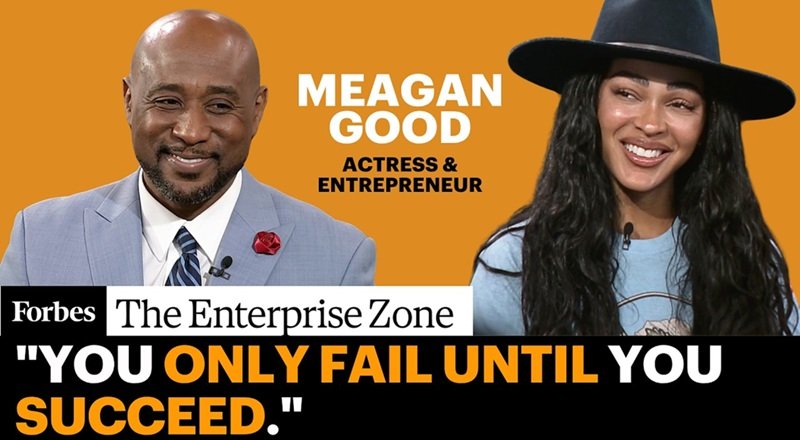
From child star to investor, the actress-producer-entrepreneur is rewriting the playbook for longevity—and ownership.
Meagan Good’s 30-year career in Hollywood—spanning 40+ commercials, iconic roles in Friday, Think Like a Man, and Harlem, and a #1 box-office hit—was never just about fame. It was about leverage.
“I realized early that God gave me this platform for a purpose,” she told Forbes at Nasdaq’s MarketSite. “If I only focused on acting, I’d miss the bigger opportunity: ownership.”
Her turning point? Financial trauma. Despite top-billing roles, she found herself broke after a #1 movie—a result of poor money management, boundary-less generosity, and industry exploitation. “I’d pay everyone’s bills, let people move in, and end up with nothing,” she admits. “I had to learn: God didn’t call me to be a bank.”
The solution? Threefold:
- Hire a ruthless business manager (Joshua Schmemell, who “teaches, not just manages”).
- Adopt the “first-check rule” (à la Courtney B. Vance and Angela Bassett): Live off acting income; invest the rest.
- Shift from talent to tycoon: Produce, direct, and invest in ventures aligned with her values.
The Business Portfolio: Where Passion Meets Profit
Good’s enterprise ecosystem is diverse, scalable, and built for legacy:
1. Nebula9 Spirits: The Health-Conscious Vodka Play
- The Product: Apple cider vinegar-infused vodka—no sugar, no hangovers, metabolized faster.
- The Hook: “I tested it at 8 PM, woke up at 4:15 AM for the gym—no crash.”
- The Strategy:
- Partnered with Black founder Keith Davis (a “genuine, mission-driven” entrepreneur).
- Expanding into Costco, Jamaica, Nigeria, and airports—targeting the $2T Black spending power.
- Positioning: Not just a celebrity endorsement, but a cultural reset in spirits. “We’re redefining what it means to drink responsibly.”
- Ownership: Equity stake + creative control (unlike traditional celebrity liquor deals).
2. Honor Culture: The Wellness Empire
- The Brand: A fitness apparel and community co-founded with husband Jonathan Majors, blending athleisure, digital workouts, and mental health.
- The Differentiator:
- Apparel designed for Black bodies (e.g., hair-protective fabrics).
- App in development (scalable global memberships, multilingual content).
- Events like “Alpha Land” (Texas-based fitness festivals).
- Revenue Model: Direct-to-consumer + subscriptions (avoiding retail markups).
3. 31 Entertainment: The Production Powerhouse
- The Slate:
- A Tyler Perry-backed film (directorial debut, 2024 release).
- Unannounced projects (focused on “authentic Black stories”).
- The Play: **”We’re not just making content—we’re owning the IP.”*
- Why It Works: Hollywood’s hunger for diversity meets Good’s 30 years of industry relationships.
4. Good Girl Raps: The Haircare Disruptor
- The Product: Satin-lined rap caps (protects hair during workouts/sleep).
- The Genius: Solved a $2.5B problem (Black women’s hair damage from exercise).
- The Scale: No paid ads—organic growth via word-of-mouth and authenticity.
The Investment Philosophy: “If It’s Not Aligned, It’s a Distraction”
Good’s capital allocation follows three rules:
- Passion First: “We only invest in what we live and believe in.”
- Example: Nebula9 (health-conscious), Honor Culture (fitness as faith).
- Ownership Over Endorsements: “I don’t just lend my name—I build equity.”
- Contrast: Most celebrity brands sell for quick cash (e.g., Kylie Cosmetics’ $600M sale to Coty). Good retains stakes.
- Long-Term Plays: “We’re not flipping—we’re generational.”
- Target: Africa and the diaspora (e.g., Nebula9’s Nigeria expansion).
“Jonathan and I ask: ‘Does this align with our story?’“, she says. “If not, we pass—no matter the ROI.”
From Broke After a #1 Movie to Millionaire Mindset
Good’s hardest lesson? “Bleeding-heart syndrome.”
- Early Career: “I’d help everyone—then have no savings.”
- The Shift:
- Boundaries: “God didn’t tell me to fund others’ lifestyles.”
- Systems: Separate LLCs for each venture (asset protection).
- Reinvestment: Profits from Harlem and Shazam! funneled into Nebula9 and Honor Culture.
“I used to think generosity = godliness,” she reflects. “Now I know stewardship is sacred.”
Why Black Women Are the Ultimate Entrepreneurs
Good’s journey mirrors a broader shift:
- From “Talent” to “Tycoon”: Black women are launching businesses at 3x the national average (2023 American Express report).
- The Ownership Gap: While Black women lead in startup formation, they receive <1% of VC funding.
- Her Solution: Group economics (e.g., church-backed syndications, diaspora investments).
“We’ve always been resourceful,” she says. “Now we’re owning the resources.”
The Legacy Play: Building for the Next Generation
Good’s exit strategy isn’t an exit—it’s a transition:
- Family Office: Sons will inherit debt-free, cash-flowing assets (real estate, IP).
- Mentorship: Honor Culture’s app will include financial literacy modules.
- Philanthropy: Reinvesting in Santa Clarita (her hometown, where racism shaped her resilience).
“I want my kids to see wealth as normal,” she says. “Not as a miracle—as a mindset.”
Wealth Is a Team Sport
Meagan Good’s $10,000 question (literally): “If you gave me $10K right now, what’s the first investment?”
Answer: “Apple—and more equity in Nebula9.”
Her parting advice for aspiring moguls:
- “Find old heads” (mentors who’ve failed and won).
- “Live frugal” (her husband’s cross-country road trips > private jets).
- “Invest in what you use and understand” (e.g., Apple stock, not crypto hype).
“Wealth isn’t about having—it’s about holding,” she says. “And passing it forward.”