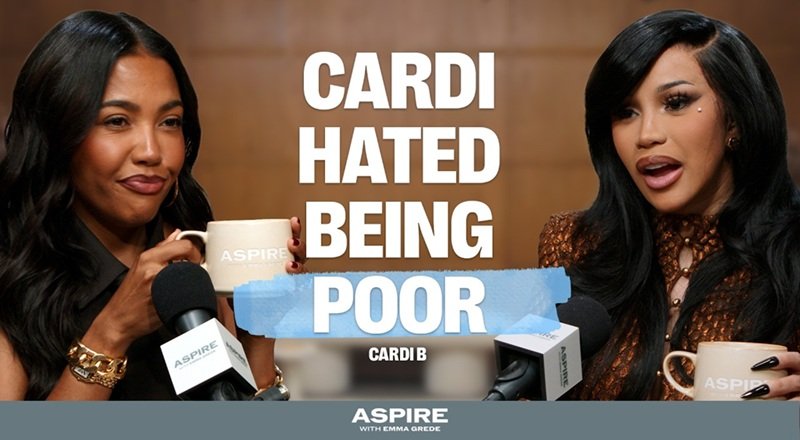
From reality TV skepticism to Grammy-winning dominance, Cardi B’s Grow Good isn’t just a haircare line—it’s a calculated strike against the industry that profited off her image without equity. Here’s how she flipped the script on brand partnerships, owned her supply chain, and built a nine-figure business on authenticity and operational control.
Cardi B’s origin story isn’t just about fame—it’s about financial survival. Growing up in the Bronx, she hated being poor not because of the lack, but because of the systemic barriers that made wealth feel unattainable. “I knew I didn’t belong in an apartment in the Bronx,” she told Emma Grede. “I knew that wasn’t my ending.”
Her early hustles—stripping, hosting clubs, selling mixtapes—weren’t just side gigs; they were capital accumulation. She reinvested every dollar into her music, bypassing gatekeepers who dismissed her as “just a reality TV girl.” When labels hesitated, she funded her first music video herself, betting $2,000 on a YouTube upload that could make or break her career. “If I get a million views, I’ll make $30,000,” she calculated. “And people will take me seriously.”
That gamble paid off. But the real lesson? “I was making everyone else rich.” By 2026, she refused to repeat the cycle.
The $30M Lesson: Why Cardi Fired Her Way to Ownership
Cardi’s first wave of success came with a harsh reality: she was the face, not the owner. Brand deals paid her millions but left her with no equity, no control. “They’d invest $500,000 in a photoshoot,” she recalled, “but nothing in advertising. They relied on me to push the product.”
The breaking point? Whip Shots, her vodka brand. She owned a sliver of equity but had no decision-making power. “I’d say, ‘We need better marketing,’ and they’d ignore me,” she said. “I was making them rich, but I wasn’t rich rich.”
Her solution:
- Fire underperforming partners. “If you’re not ambitious like me, you’re gone.”
- Demand transparency. “I need to see the numbers daily. No ghost equity.”
- Build in-house. For Grow Good, she assembled a team that shared her urgency—no middlemen, no excuses.
The result? A haircare line where she owns the formula, the marketing, and the margins.
Grow Good’s Secret Weapon: Dominican Onion Water and Lab-Tested Obsession
Grow Good isn’t just another celebrity brand. It’s a lifelong obsession turned into a scalable business.
- The Formula: Cardi tested products on her own hair, rejecting 30+ iterations of a wig remover until it met her standards. “If it doesn’t penetrate my braids, it’s trash,” she declared.
- The Name: “Grow Good” reflects her Dominican roots (onion water rinses) and her no-BS approach to beauty. “I boiled onions at 13. I know what works.”
- The Distribution: She skipped wholesale, launching DTC on grow.hair before Target, Ulta, or Sephora. “I want it everywhere—but on my terms.”
Her biggest flex? No celebrity co-signs. “I don’t need Rihanna’s approval,” she said. “I need reviews saying this shit is life-changing.”
“I Want It All:” The $100M Blueprint for Black Women in Beauty
Cardi’s endgame isn’t $100M in revenue—it’s $100M in legacy. Her three-phase plan:
- Phase 1: Prove the Product (2026)
- DTC-only launch to build hype and control quality.
- Leverage her 150M+ social following—but not as the sole marketer. “I’m not paying for ads. The product sells itself.”
- Phase 2: Dominate Retail (2027–2028)
- Target, Ulta, Sephora—but only after demand is undeniable.
- No discounting. “I’m not competing on price. I’m competing on results.”
- Phase 3: Global Expansion (2029+)
- Middle East and Latin America first—markets where her star power translates to sales.
- Franchise salons under the Grow Good brand, offering hair treatments alongside products.
Her mantra: “I want it in every beauty supply. I want a woman in Dubai to say, ‘This is Cardi’s shit.’”
The Libra Effect: Why Cardi’s Work Ethic Is Her Superpower
Cardi credits her Libra sign for her relentless drive—but her real superpower is systems.
- Daily Routine: Wakes at 10 AM (after studio sessions until 5 AM), calls her team immediately with new ideas. “If I think of it at 2 AM, I’m waking someone up.”
- No Excuses Culture: “You don’t like tutoring? Too bad. You’re doing piano and soccer.” (Her four kids follow the same rule.)
- Financial Discipline:
- Cuts frivolous spending (e.g., private jets—“I’d rather put that into marketing”).
- Audits every contract. “If you’re overcharging me, you’re fired.”
- Reinvests profits into real estate (Atlanta, Miami) and Black/Latina-led startups.
Her advice to women: “Stop making excuses. Nobody cares about your struggles. Do the work.”
The Coldest Winter Ever: How a 13-Year-Old’s Playbook Built an Empire
Cardi’s business bible? Sister Souljah’s The Coldest Winter Ever. She read it at 13 and reread it at 18—not for the drama, but for the mindset.
- Key Takeaway: “Winter [the protagonist] talks like she’s the baddest bitch in Brooklyn. That’s how I walk into rooms.”
- Application:
- Negotiations: “I don’t flinch. I say, ‘This is the deal. Take it or leave.’”
- Branding: “I don’t care if people call me vulgar. I know when to turn it up or dial it back.”
- Legacy: “I want my kids to say, ‘Damn, my mom built this.’ Not ‘She was just famous.’”
Her 2026 motto: “Prayer with no movement is just noise.”
The $1B Question: Can Cardi B Outscale Fenty?
Rihanna’s Fenty redefined beauty. Cardi’s Grow Good aims to redistribute the wealth.
- Fenty’s Model: Celebrity + Inclusivity = $2.8B valuation.
- Cardi’s Edge:
- Authenticity: “I’m not a ‘clean’ brand. I’m a real brand.” (Her unfiltered social media is her best ad.)
- Ownership: No outside investors—she funded Grow Good herself.
- Speed: From concept to launch in 18 months (Fenty took 3 years).
Her ultimate goal? “I want a billion-dollar exit—but I’m keeping 51%.”