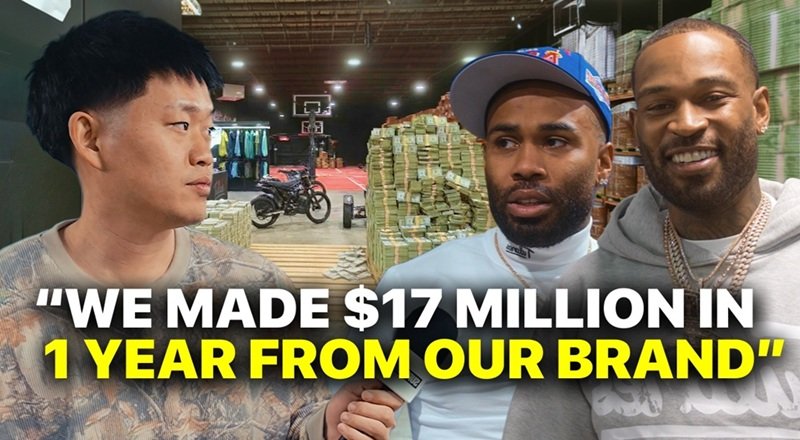
Dolla and Benji, the founders of Tulones, turned a basement operation into a $17 million revenue machine—not through celebrity co-signs or venture capital, but by mastering supply chain leverage, direct-to-consumer precision, and the art of turning culture into capital.
In 2014, Dolla and Benji invested $20,000 in a custom headband—a gamble that sold 3,000 units in weeks and revealed a critical insight: Black consumers would pay for exclusivity over trends. This wasn’t luck; it was the first test of a model that would later generate $17 million annually—not through viral moments, but through relentless supply chain control and direct-to-consumer precision.
The brothers’ basement operation evolved into a warehouse empire, where every stitch, mold, and barcode was designed to eliminate middlemen and maximize margins. Their no-loss philosophy—treating even a $15,000 basketball court as an asset, not an expense—set the foundation for a brand that outperformed competitors by ignoring industry conventions.
The Alibaba Playbook: How Tulones Outmaneuvered Fast Fashion
While competitors chased influencer deals, Tulones mastered Alibaba. The brothers reverse-engineered products from templates, negotiated mold fees (e.g., $6,500 for a custom toothbrush), and secured bulk shipping discounts—cutting costs by 30–50% compared to rivals.
Their supply chain strategy was ruthless:
- Pakistan for speed: “We get products in half the time of China,” Benji noted, citing trade-friendly import laws.
- China for scale: “Bulk orders cost double if you don’t know the right factories,” Dolla added, emphasizing their network of vetted manufacturers.
- No trade shows: “We skip the middleman and go straight to the source,” they explained, avoiding markups and delays.
This logistical dominance allowed them to stockpile inventory during pandemics (when competitors ran out of product) and launch accessories (bikes, skateboards) at lower costs than traditional apparel.
The 500,000-Subscriber Secret: How Tulones Built a Cult Without Ads
Tulones never paid for ads. Instead, they systematized word-of-mouth:
- Pop-up shops in unconventional venues (e.g., coffee shops, barbershops) created local buzz.
- Email lists grew organically to 500,000+ subscribers—without paid campaigns.
- Omnisend automation recovered $68 per $1 spent on abandoned carts, turning casual browsers into repeat buyers.
“The streets were already behind us,” Benji said. “We just gave them a system to engage.”
Their SMS and email sequences mimicked luxury brands (e.g., Nike, Reebok), but with a streetwear twist: exclusivity without elitism.
“We Don’t Believe in Losses:” The Financial Philosophy Behind $1M Sales Days
Tulones rejects the “sell-out” mentality. Instead, they prioritize consistency:
- Staple items (hoodies, tees) are always in stock, ensuring reliable revenue.
- New designs are tested in small batches—only scaled if they sell.
- $1 million+ sales days came from pre-existing inventory, not hype-driven drops.
“A $28 bike costs less to make than a varsity jacket,” Dolla explained. “We invest in molds, not marketing.”
This asset-first approach turned warehouse space into a profit center—where even a basketball court served as a team-building tool and brand asset.
The Warehouse as a Weapon: How Tulones Turned Logistics Into Luxury
Their Atlanta warehouse isn’t just storage—it’s a competitive advantage:
- Barcoded inventory ensures fast fulfillment (critical for DTC dominance).
- Custom packaging (frosted bags, hang tags) makes every order feel premium.
- A “fantasy factory” vibe (e.g., bikes, skateboards, Airbnb extensions) deepens customer loyalty.
“Most brands rent space,” Benji said. “We own the experience.”
The Racial Bias Incident That Reinforced Their “No Apologies” Approach
When a Black entrepreneur friend was questioned by a white landlord (“Can you afford this?”), Dolla and Benji doubled down on their “paperwork first” rule:
- No in-person negotiations: “We email contracts—no small talk,” Dolla said.
- Credit scores and cash reserves speak louder than racial assumptions.
- Warehouse ownership became a symbol of economic defiance.
“We don’t ask for permission,” Benji noted. “We show receipts.”
The $17M Question: Can Black Brands Scale Without Selling Out?
Tulones proves that scaling doesn’t require celebrity co-signs or venture capital. Their $17M revenue came from:
- Ownership (supply chain, data, real estate).
- Reinvestment (profits fund community giveaways and new ventures).
- Patience (“Enjoy the process,” Dolla advised their 18-year-old selves).
The real flex? No losses. No handouts. Just systems that outlast trends.